
Last updated November 15, 2026
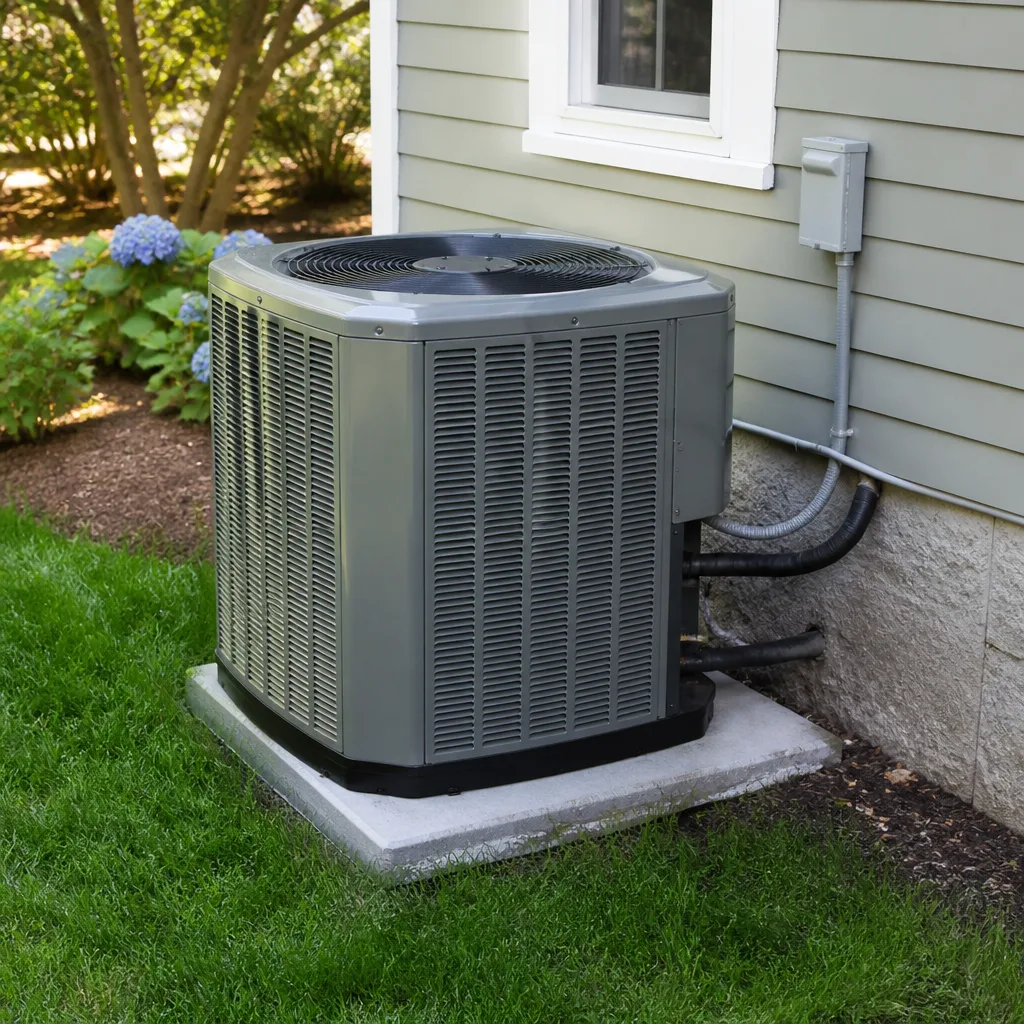 AC repair
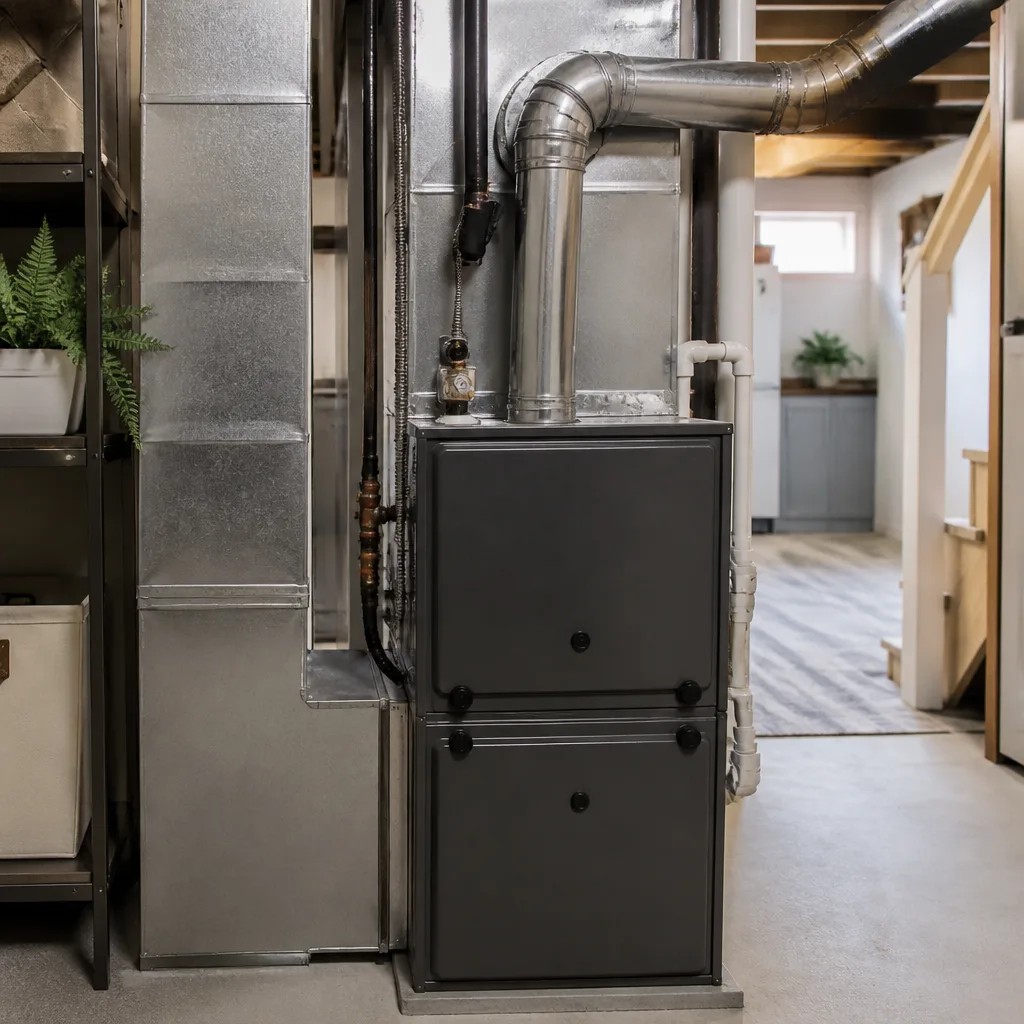 Furnace & heating
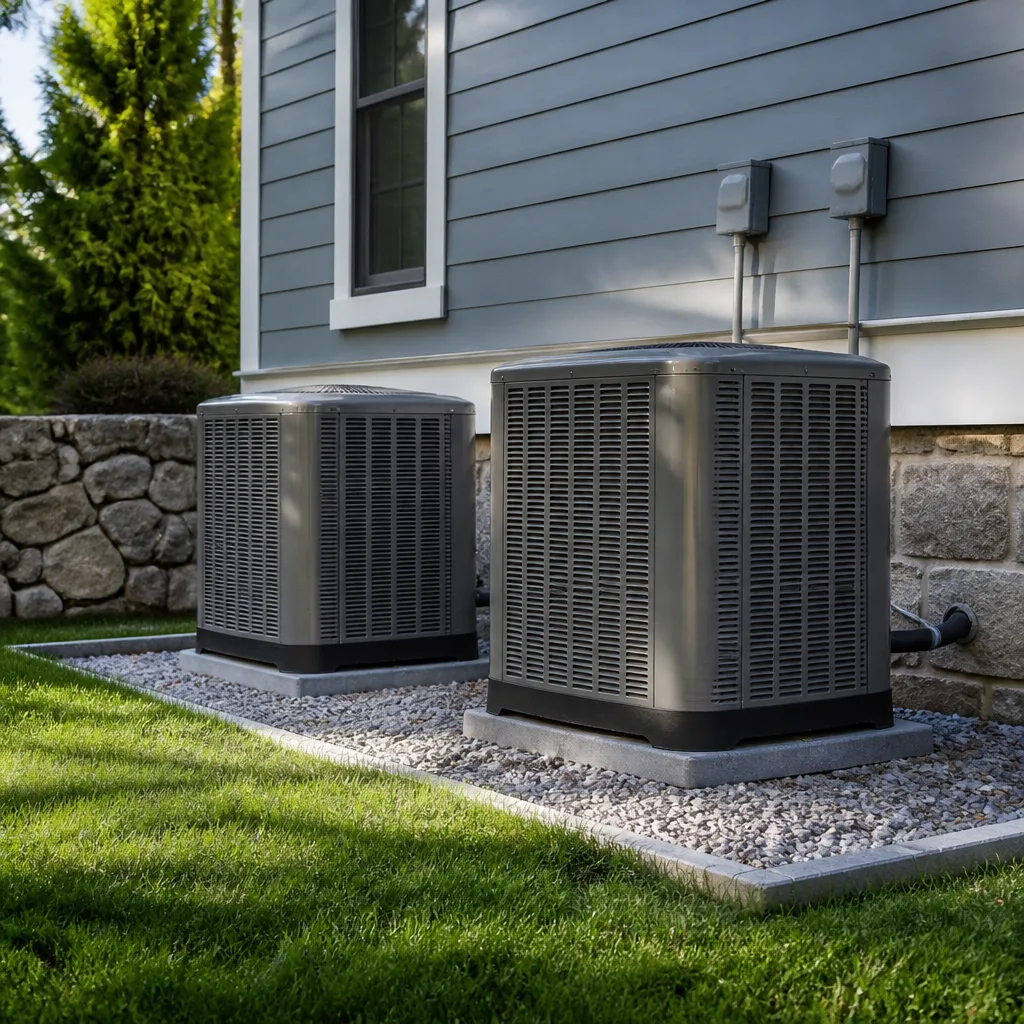 Heat pumps
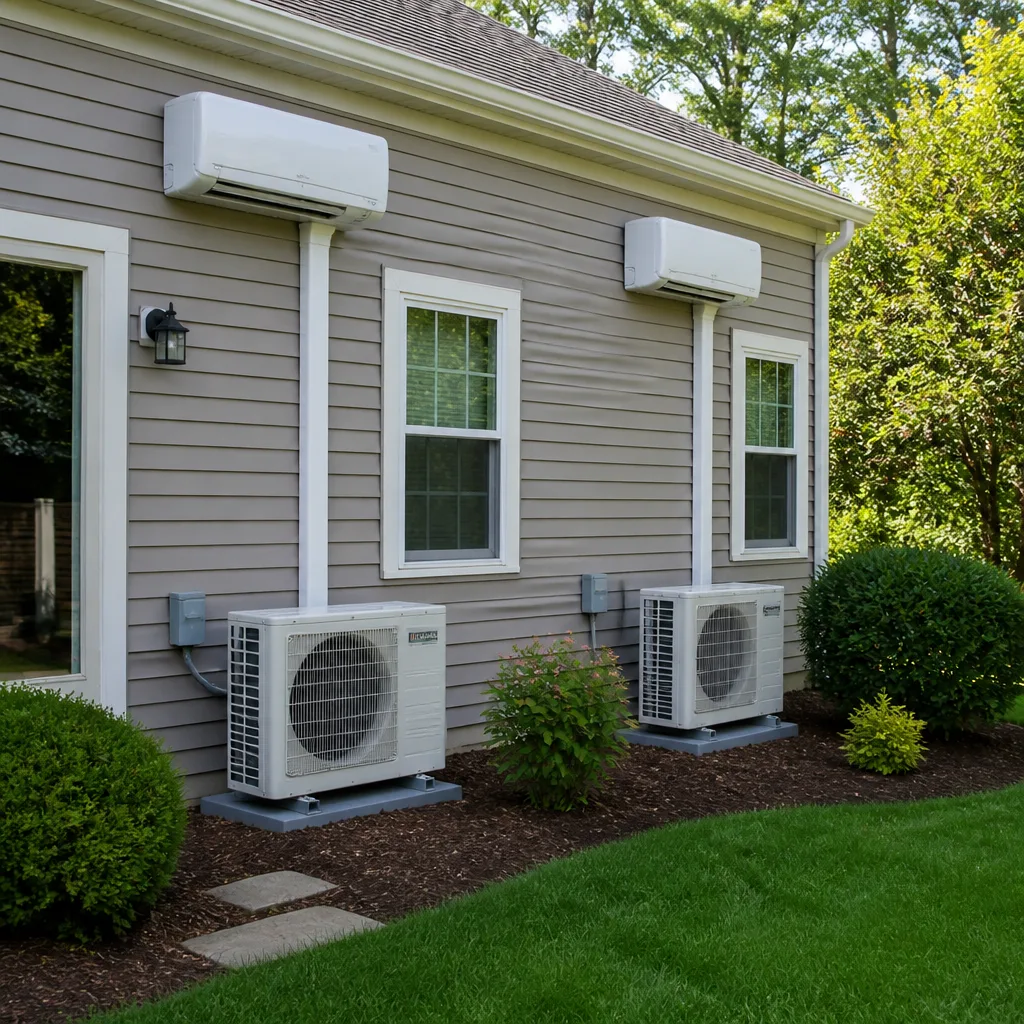 Ductless mini splits
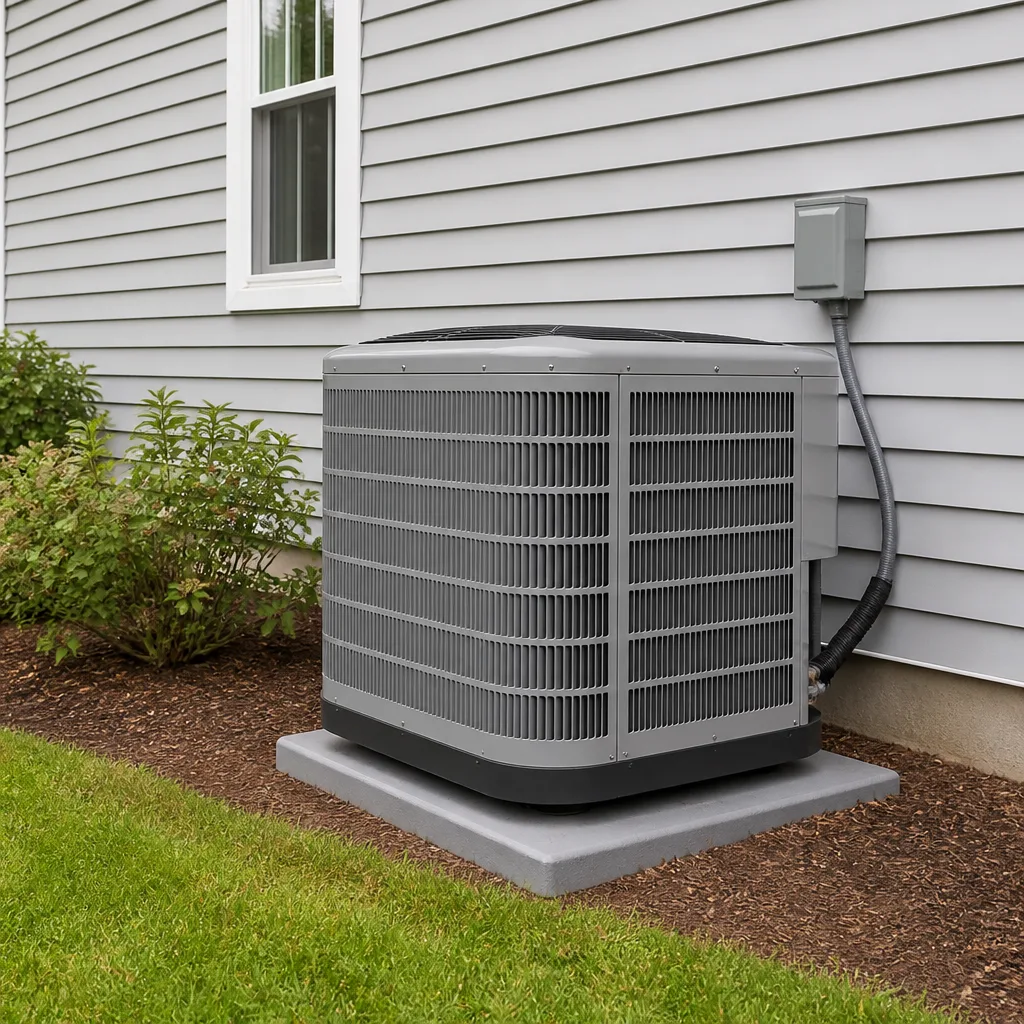 Carrier
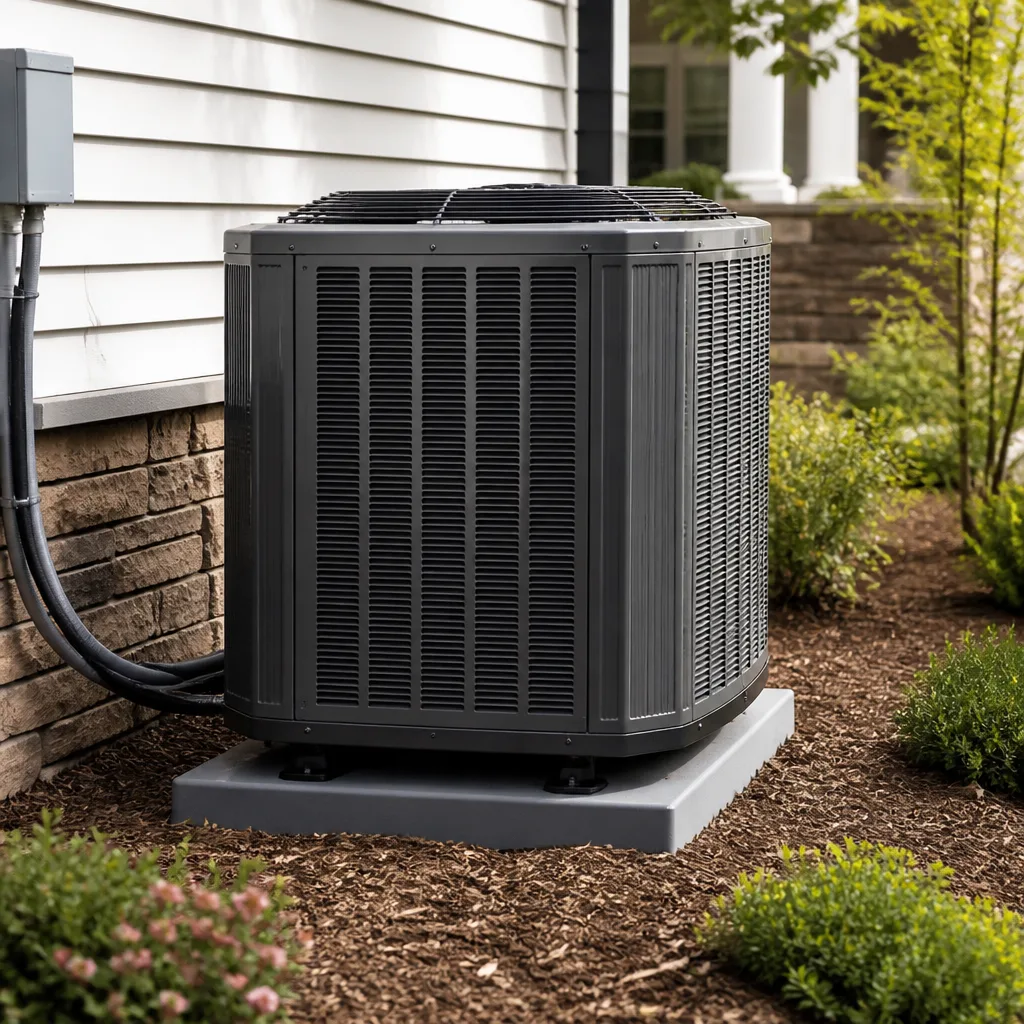 Trane
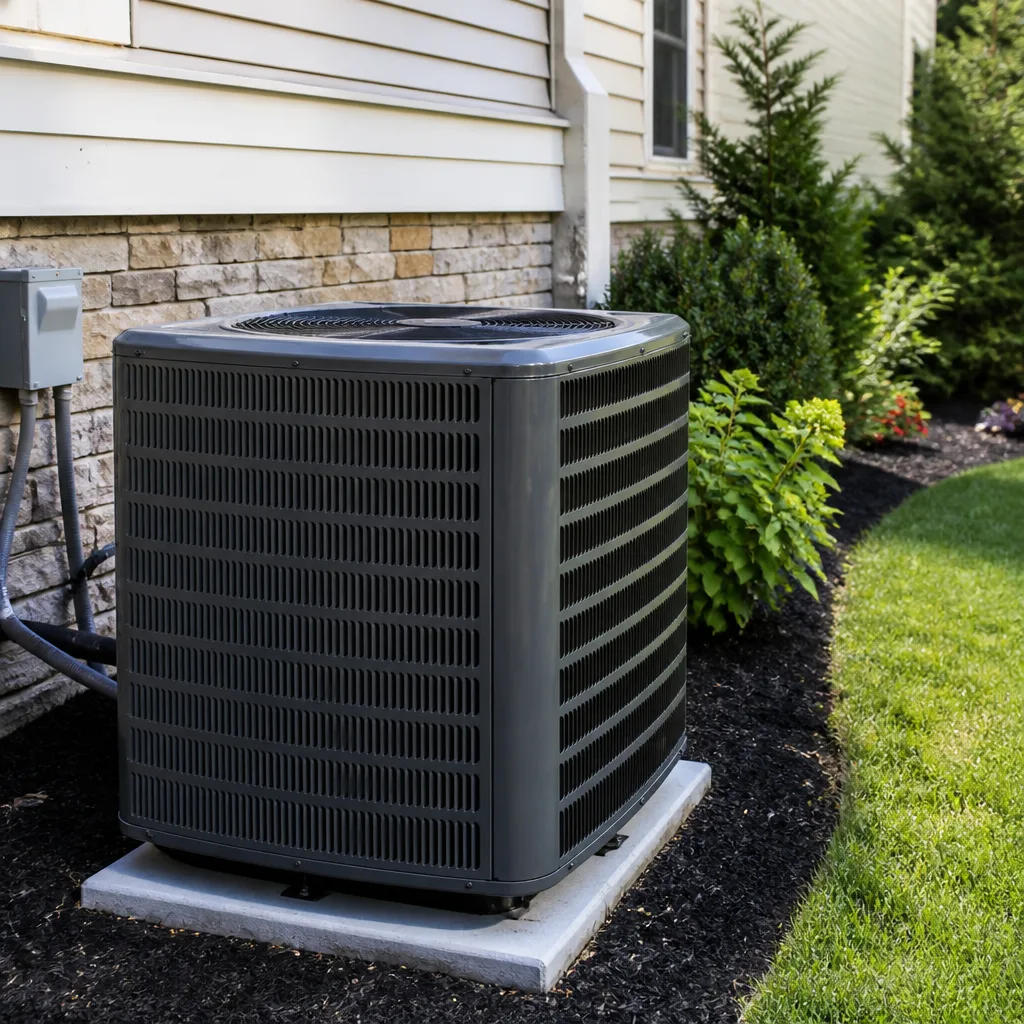 Goodman
Seasonal tune-up and full diagnostic on your Carrier, Trane, or Goodman system - readings shown to you before any repair is proposed
Diagnosis first, numbers second - you approve the repair price before a single part goes in.
Get your free estimateHVAC Warning Signs: A Pompano Beach Homeowner’s Reference Guide
Most homeowners wait for a dramatic failure: a bang, a dead thermostat, a puddle on the floor. Those are not warning signs. Those are symptoms that arrive after the warning signs were ignored for weeks. In Pompano Beach, a cooling system rarely dies without notice. It sends quieter signals first. Cycle length creeps upward. The house feels slick at 74 degrees even though the thermostat reads 72. The breaker trips once, then twice. This guide translates what those signals actually mean, so you can act on a pattern shift instead of a breakdown. We’ll cover runtime benchmarks, the humidity-specific clues that only show up in South Florida, leak detection before ice forms, and the electrical sounds that announce a failing capacitor long before the compressor gives out.
Quick Answer
The earliest HVAC warning signs in Pompano Beach usually show up as a change in pattern rather than an obvious failure: cycles run longer than they used to, indoor humidity climbs above 60% while the system is running, or you hear a hard click before the unit starts. A system that has to run steadily in June and still can’t reach setpoint is not “working hard because it’s hot.” It’s signaling that refrigerant charge, coil condition, or duct integrity has degraded, and you are weeks, not months, from a failure. The three most reliable early signals are creeping runtime, rising humidity, and starting hesitation.
Styles & brands we work with
- AC repair
- Furnace & heating
- Heat pumps
- Ductless mini splits
- Carrier
- Trane
- Goodman
Table of Contents
- Why Cycle Length Tells You More Than Any Gauge
- The South Florida Humidity Signs Temperate Guides Miss
- Refrigerant Warning Signs Before Ice Forms
- Electrical and Capacitor Failure Precursors
- How to Log Warning Signs Like a Technician
- Warning Signs by System Age and Equipment Type
- What Pompano Beach Climate Does to Equipment
- When a Warning Sign Means Repair, Not Replacement
Why Cycle Length Tells You More Than Any Gauge
A healthy air conditioner runs in cycles, not continuously. Run time is the single most useful signal a homeowner can track because it changes gradually and it changes for a reason. In a temperate climate, a system might run 30 to 40 minutes in a hot afternoon and rest for a similar stretch. In Pompano Beach, where summer afternoons sit in the upper 80s and low 90s with high humidity, that cycle lengthens naturally. What you’re watching for is a shift from your own baseline, not a comparison to a national average.
Here’s a workable starting framework for a Pompano Beach home with average attic insulation and typical window coverage:
- Under 1,200 sq ft: a healthy system cycles roughly 15 to 20 minutes on and 10 to 15 off during peak afternoon heat.
- 1,200 to 1,800 sq ft: 20 to 30 minutes on, 12 to 18 off is a reasonable band.
- 1,800 to 2,500 sq ft: 30 to 40 minutes on, 15 to 20 off.
- Over 2,500 sq ft: 40 to 50 minutes on, 15 to 25 off, or a two-stage system running longer at lower capacity by design.
Those numbers are a starting point, not a rule. A well-sealed house with a properly sized system runs shorter. A house with a west-facing wall of single-pane glass runs longer. What matters is drift. If your system used to hit setpoint in 25 minutes and now takes 45 while the outdoor temperature hasn’t changed, something degraded. The usual suspects, in order: a dirty evaporator coil, a partially blocked condensate drain causing a float switch to cycle the compressor, low refrigerant charge, or duct leakage in the attic where the return plenum connects. If a system began cycling in short bursts of three to five minutes with long off periods, that’s a different problem entirely, likely a failing capacitor or a control board issue. Neither pattern gets better on its own.
One more subtle cue: listen for the compressor to cut out before the thermostat is satisfied. If the outside unit stops while the indoor blower keeps running and the house is still warm, that’s a protective shutdown, usually high head pressure or low charge. It’s a hard stop, not a normal cycle.
The South Florida Humidity Signs Temperate Guides Miss
Every generic HVAC article will tell you to watch for warm air and strange noises. Almost none will tell you to watch a hygrometer. In Pompano Beach, humidity control is half the job of your air conditioner, and it is the first thing to degrade when the system loses efficiency. An air conditioner removes moisture by running long enough for the evaporator coil to drop below the dew point. If cycle times shrink because the compressor is short-cycling, or if the coil is dirty and can’t build a proper temperature differential, the house gets cold and clammy at the same time.
These are the three humidity signs that only appear in a climate like ours:
- Indoor humidity holding above 60% while the system is running. A healthy system in Pompano Beach should keep indoor relative humidity between 45% and 55% during the cooling season. If it can’t pull below 60%, either the coil isn’t cold enough to condense moisture, airflow is too high across the coil (a blower set too aggressively), or the system isn’t running long enough per cycle.
- Sticky floors, condensation on interior window glass, or bathroom mirrors fogging from room temperature. These are signs the air is saturated, not just humid. You’ll often notice them in the morning before the sun gets up.
- Mildew smell from supply registers that fades when the system runs and returns when it stops. That’s moisture sitting on the coil or in the drain pan between cycles. It also means the condensate drain isn’t carrying water away fast enough, and a slow drain eventually becomes a float switch trip or a ceiling stain.
Humidity readings also shift with outdoor conditions. A wet week after heavy rain will push indoor levels up regardless of equipment health. What you’re watching for is a persistent change across a normal week, not a spike on a stormy afternoon. If you’ve never measured it, a $15 digital hygrometer placed on an interior wall away from the return is one of the most useful diagnostic tools a Pompano Beach homeowner can own.
Refrigerant Warning Signs Before Ice Forms
Most homeowners learn they have a refrigerant leak when they see ice on the copper lines or the indoor coil. By then, the leak has usually been active for weeks or longer. Refrigerant doesn’t get consumed by the system. It’s a sealed loop. If the charge is low, refrigerant left through a leak somewhere, and there is a source that needs to be found. “It just needs a top-off” is not a diagnosis. It’s a delay that guarantees you’ll be back on the phone in a few months.
The early warning signs, in the order they usually appear:
- Longer runtimes with no drop in indoor temperature. The first sign of low charge is a system that runs steadily but can’t bring the house down to setpoint. It runs, gets close, and gives up.
- Warm air at the supply registers at the start of a cycle, then cooler air after a few minutes. With low charge, the evaporator coil takes longer to reach full temperature differential.
- A slight hiss or gurgle at the indoor unit when the system starts. That’s the sound of refrigerant flashing across a partially starved metering device.
- The outdoor unit running noticeably hotter than usual, or a compressor that sounds strained. Low charge makes the compressor work harder and run hotter.
- Oil residue or a faint chemical smell near the indoor coil or line-set connections. Refrigerant carries lubricating oil with it, and leaks often leave traces at the joint where the oil escaped.
None of these looks dramatic. That’s the point. Ice on the line set, the classic “obvious” sign, shows up only after pressure has dropped far enough to freeze condensate, which takes time. On a Pompano Beach system running through a sticky June, that can be several weeks after the leak started. If you notice any of the above, the next step is a proper leak search, not a recharge.
Electrical and Capacitor Failure Precursors
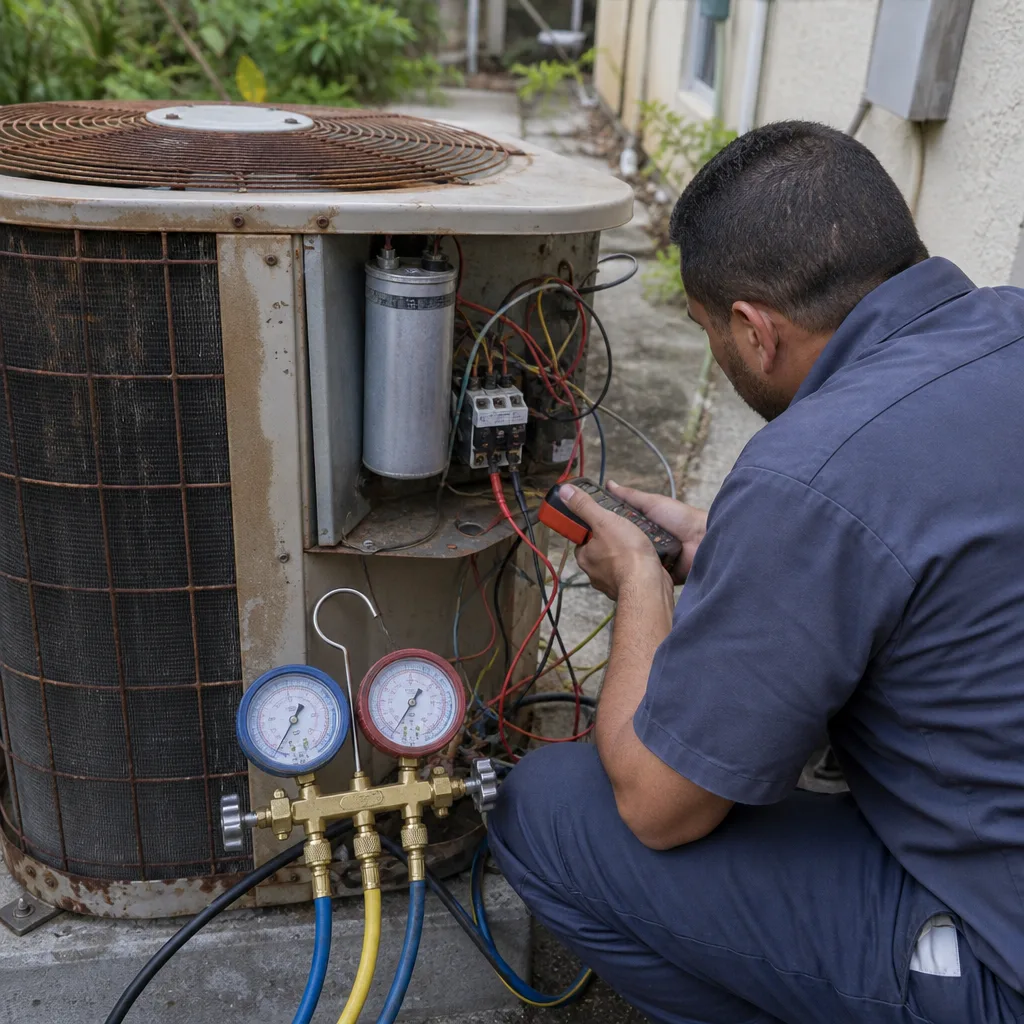
Capacitor failures are the most common compressor-side failure we see in South Florida heat. The capacitor is a small cylinder inside the condenser cabinet that gives the compressor and fan motor the boost to start. Heat degrades it. High outdoor temperatures accelerate the process. In a Pompano Beach summer, a condenser sitting in full afternoon sun will see cabinet temperatures well above outdoor ambient, and the capacitor ages faster than it would in a cooler climate.
The failure rarely happens without warning. Listen for these:
- A hard click before the fan or compressor starts, followed by a delay of several seconds. A healthy start is immediate. A hesitate-click-start pattern means the capacitor is losing its ability to deliver starting torque.
- The outdoor fan spinning slowly at first, or failing to spin while the compressor hums. A weak run capacitor shows up here first. The compressor is trying to start into a heat-locked system, and if you leave it there, it will eventually trip the breaker or trip its internal overload.
- Breaker trips that reset cleanly, then trip again a few days later. Once is an anomaly. Twice is a pattern. A tripping breaker on an AC circuit almost always points to a failing component drawing more current than it should, and a bad capacitor is a common cause.
- Thermostat display flickering or resetting when the compressor kicks on. If the thermostat drops and reboots every time the outdoor unit starts, you have a voltage sag on the low-voltage side, often a failing contactor or a control board losing power mid-call.
- A “humming but not spinning” condenser fan. This is a running-capacitor failure and it can destroy a compressor in hours if left alone in high heat.
If your system is showing a hesitate-click-start pattern, stop running it and get a technician out. A capacitor is a low-cost part. A compressor is not, and a compressor replacement usually costs more than the remaining life of the equipment is worth in a small single-story Pompano Beach home.
How to Log Warning Signs Like a Technician
When you call for service, the difference between a fast diagnosis and a slow one is often the quality of information you can give the technician. “It’s not cooling right” is a starting point. “It runs 45 minutes instead of 25, the indoor humidity has been 62% for a week, and the breaker tripped twice last Tuesday” is a diagnostic brief. The technician still verifies everything, but the visit starts with direction rather than guesswork.
Here’s a simple observation log that takes one minute a day during the cooling season:
- Date and time of observation. Keep it consistent, ideally around the same hour each day so conditions compare cleanly.
- Outdoor temperature and approximate conditions. “Upper 80s, humid, no rain” is enough.
- Thermostat setpoint and actual reading. A system that reads 76 when set to 72 is telling you something.
- Approximate cycle length. Time it once or twice a day. A phone stopwatch is fine.
- Indoor humidity reading. From the hygrometer on an interior wall, not near a vent.
- Any sound, smell, or starting hesitation you noticed during the day. Note time and what the system was doing.
- Anything unusual: breaker trips, water near the indoor unit, ice on the line set, thermostat reboots.
Two weeks of logging tells the story. If the pattern is drifting, the numbers will show it far more clearly than a memory of “it seems to run longer than it used to.” Bring the log to the service visit. Any technician will read it before opening the panel, and the technician who reads it walks in already narrowing the fault.
If you need AC repair in Pompano Beach and you don’t have a log, describe the shift in plain terms when you call: when it started, what you’ve noticed, and what’s different from last summer. That’s still useful.
Warning Signs by System Age and Equipment Type
Different vintages of equipment fail in different orders. If you know roughly how old your system is, you can weight the warning signs you’re seeing against what typically fails first.
- Under 8 years: expect the equipment to be near its spec. Warning signs at this age usually point to installation issues (undersized ducts, incorrect charge at startup, blower speed set wrong), a dirty coil, or a refrigerant leak from a bad braze joint. These are fixable, and often the fix is worthwhile.
- 8 to 12 years: the capacitor-and-contactor era. Electrical components age, the compressor still runs, but the drain pan is starting to pit and the coil fins are losing their edge. This is where a good technician earns their keep, because the system still has life in it.
- 12 to 16 years: the decision window. R-410A systems installed in the mid-2010s are now at the far end of their typical service life in a Pompano Beach climate. Warning signs at this age are worth weighing against replacement rather than reflexively repairing.
- Over 16 years: every repair competes with the remaining life of the equipment. The honest math is : if you’d put in more than a third of a new system’s cost on a repair to a 16-year-old unit, the answer is usually replacement.
Equipment-specific notes: a variable-speed Daikin or Bryant system has a control board that will log faults internally. If you have one, warning signs you can’t explain from behavior are often visible as stored fault codes to a technician within a minute of hooking up a diagnostic tool. A fixed-speed York or American Standard system won’t store that history, which is why the homeowner log matters more on those units. Our technicians work on all four of those brands, along with Carrier, Trane, Lennox, Goodman, and Rheem. We work on the system you have, not the brand we’d like to sell you.
What Pompano Beach Climate Does to Equipment
Pompano Beach systems work harder than the national average, and they work harder for longer. Cooling season effectively runs from April through October, and shoulder months mean the system runs in shorter bursts during the hot part of the day and rests overnight. That on-off pattern is actually harder on capacitors and contactors than continuous running, because every start is a surge. The equipment that lives the longest in this climate is the equipment that starts the fewest times per day, which is why a properly sized, well-maintained system beats a half-maintained larger one every time.
A few local realities that change what warning signs mean:
- Attic temperatures in Pompano Beach routinely top 130 degrees in July and August. Any duct run through the attic loses cooling to the attic itself, and a duct with a small tear or a loose joint distributes the loss evenly across every room it serves. This shows up as a system that can’t hit setpoint even though it’s running well, with no obvious refrigerant or capacitor symptom.
- Humidity loads peak mid-afternoon when the sea breeze dies and the air sits. A system that handles morning load fine but can’t pull the house down by 4pm is telling you the coil has lost some of its temperature differential. That’s a coil-cleaning sign, or a low-charge sign, and the two are worth separating.
- Older housing stock in Pompano Beach neighborhoods often has single-pane windows, west-facing sliding glass doors, and original 1980s-era ductwork. Insulation and window upgrades change the load, and a system sized for the original home may now be significantly oversized. An oversized system short-cycles, doesn’t dehumidify well, and stresses the compressor with too many starts per day.
- The rainy season floods the condensate drain. A float switch trip is not a warning sign. It’s a completed warning sign. If your system has shut off on a humid day and the indoor unit looks dry, check whether the condensate drain line exiting the house is running water. If it’s not, the drain is blocked, which means a technician needs to clear it before you run the system again.
If you’ve got an older system and you’re wondering whether the warning signs you’re seeing add up to repair or replacement, the answer usually comes down to what a technician finds in the first hour. If you want a second opinion, our AC installation team will tell you plainly whether a new system actually makes sense or whether the existing one has several good years left in it.
When a Warning Sign Means Repair, Not Replacement
Warning signs are informational. They tell you something changed. What they don’t tell you is what to do about it, and that’s where homeowners often jump to the wrong conclusion in one direction or the other. Some homeowners see a capacitor hesitation and panic, assuming a new system is coming. Others see a creeping runtime pattern and ignore it, assuming that’s just what an aging unit does. Both are wrong.
A repair is the right call when the warning sign traces to a discrete, replaceable component: a capacitor, a contactor, a control board, a clogged condensate line, a dirty evaporator coil, a refrigerant leak with a findable source and a proper repair. These fixes restore the system to spec, and you keep the remaining life of the equipment you already paid for.
Replacement starts to make sense when warning signs stack up and the cost of repairs approaches a meaningful fraction of a new system, or when the equipment’s age in a Pompano Beach climate means the next failure is already loading. If you’ve had two repairs in twelve months and the system is over 12 years old, you’re past the tipping point. If you’ve had one repair in five years and the system is 8 years old, keep repairing it. Our recommendations are based on the system in front of the technician, not on a brand quota or a sales target.
Common Mistakes to Avoid
- Judging by loudness instead of pattern. The most expensive failures are usually the quietest. A system that developed a rattle and gets fixed promptly is a cheaper call than one that’s been quietly running 50-minute cycles for a month.
- Topping off refrigerant without a leak search. The refrigerant left through a hole somewhere. If your technician doesn’t look for the leak, you’ll be paying for the same work again next season. Ask where the leak was found.
- Ignoring a single breaker trip. Once can be a fluke. Twice is a pattern. A tripping breaker is telling you a component is drawing too much current, and on a South Florida condenser that component is often a capacitor on its way out.
- Running the system after the outdoor fan stops spinning. A running compressor with a dead fan will overheat in minutes. Shut down the system at the thermostat and call for service rather than letting it run.
- Watching the indoor temperature and ignoring the humidity. In Pompano Beach, humidity is half the air conditioning job. A system that hits 72 but leaves the house at 65% relative humidity is failing, not succeeding.
- Oversizing the replacement. A bigger unit runs in shorter cycles, dehumidifies less, and starts more often. When the warning signs add up to replacement, sizing matters as much as tonnage, and that means a load calculation, not a guess from the old nameplate.
- Waiting until the system dies mid-July. Warning signs give you weeks. Use them. A planned replacement in May is a very different experience from an emergency replacement the week before a holiday.
See the difference
 Before
 After
 Before
 After
 Before
 After
When to Call a Professional
Call when a warning sign has become a pattern. One long cycle on a hot afternoon is weather. A week of 45-minute cycles is a system problem. Call when the breaker trips twice in a month, when indoor humidity stays above 60% through a normal day, when the outdoor unit hesitates before starting, or when you hear the fan spinning while the compressor hums. Call when you see ice on the line set, water near the indoor unit, or a mildew smell from the registers. Call when the system shuts off and won’t come back on. Capacitor and compressor work involves high voltage and stored charge, and refrigerant work requires licensed handling, so this is not a DIY domain. Our technicians at Valor AC Repair have up to 8 years of experience with every warning sign on this page, and we work on the system you already own. Valor AC Repair offers free estimates in Pompano Beach. Call (844) 952-3433. We answer 24/7. Fast dispatch from 7am to 7pm, Sunday through Friday.
Frequently Asked Questions
Longer cycle times without reaching setpoint. In Pompano Beach summer heat, a healthy system cycles in and out through the afternoon. When it starts running 45 minutes to hit a setpoint it used to reach in 25, refrigerant charge, coil cleanliness, or duct integrity has usually degraded. Call (844) 952-3433 to get a technician out before the pattern becomes a failure.
Between 45% and 55% relative humidity during the cooling season. If your indoor hygrometer reads above 60% while the system is running on a normal day, the system isn’t removing moisture properly, which usually points to dirty coils, incorrect blower speed, or a refrigerant charge problem. Call (844) 952-3433 for a diagnosis.
No. A single trip can be a rare event, but two trips in a month is a pattern, and it almost always means a component is drawing excessive current. A failing capacitor is the most common cause we see on Pompano Beach systems in summer heat, and it can damage the compressor if left alone. Call (844) 952-3433 for a proper test.
A hesitate-click-start pattern means the capacitor is losing the ability to deliver starting torque. A healthy condenser fan and compressor start immediately. Once the delay appears, the failure window is usually days to weeks, not months. Have it tested before the compressor is damaged. Call (844) 952-3433 to schedule a repair.
Musty odor from supply registers that returns when the system stops usually means moisture sitting on the evaporator coil or in the drain pan between cycles, often because the condensate drain is partially blocked. It’s a real warning sign, not a cosmetic one. Call (844) 952-3433 and get the drain cleared before the float switch trips.
Repair usually wins when one or two components have failed and the rest of the system is sound. Replacement makes more sense when repairs are stacking and the cost begins to approach a third of a new system, or when warning signs point to the compressor. Our technicians will tell you which one actually makes sense for the system in front of them, not which one is easier to sell. Call (844) 952-3433 for a free estimate.
The Bottom Line
The systems that fail in Pompano Beach are the ones whose warnings went unread. Loud noises and dead thermostats are the end of the story. The beginning is a longer cycle, a rising humidity reading, a breaker that trips twice, or a fan that hesitates before starting. Track cycle length against your own baseline. Watch your indoor humidity in the cooling season. Log what you observe so a technician can start with data. And when a warning sign becomes a pattern, call. Our team at Pompano Beach is here to diagnose the cause rather than guess at it, and we show up, we fix it, we stand behind it.
Call (844) 952-3433 for a free estimate. We answer 24/7. Fast dispatch from 7am to 7pm, Sunday through Friday.
Written by the team at Valor AC Repair.